Understanding the Concept of Good Time Management Work Plan: A Practical Guide to Better Productivity
Developing a reliable approach to managing time is something nearly everyone struggles with at some point. You might have tried numerous methods—blocking out your calendar, setting reminders, or using complex productivity apps—only to find that what worked for a colleague or a friend falls flat for you. The concept of good time management work plan is not about following a rigid schedule or forcing yourself into a mold that doesn't fit. Instead, it is about building a flexible framework that aligns with your natural rhythms, priorities, and the demands of your professional and personal life.
At its core, a good time management work plan is a structured yet adaptable system for deciding what to work on, when to work on it, and how to ensure that your energy goes toward the tasks that truly matter. It is distinct from a simple to-do list or a daily schedule because it incorporates intentional review, prioritization, and adjustment. Rather than reacting to whatever comes your way, you proactively shape your day around your most important objectives. This concept is especially relevant for adults between 20 and 50, who often juggle career growth, family responsibilities, side projects, and personal development all at once.
What Makes a Time Management Work Plan Distinct
Many people confuse a time management work plan with a basic planner or a calendar app. While those tools can support your efforts, the plan itself is a broader strategy. It includes not only the tasks you intend to do but also the reasoning behind your priorities, the resources you need, and the way you will evaluate your progress. A well-thought-out plan accounts for the fact that interruptions happen, energy levels fluctuate, and unexpected tasks arise. It builds in buffers and review points so you can adjust without losing momentum.
Another distinguishing feature is that a good time management work plan is personal. What works for a morning person in a creative field may not suit someone who operates best late at night in a data-heavy role. The concept encourages you to reflect on your own patterns—when you focus best, how long you can sustain concentration, and what types of tasks drain you versus energize you. This self-awareness makes the plan more realistic and therefore more likely to stick.
Comparatively, many popular productivity methods—such as the Pomodoro Technique, time blocking, or task batching—are individual tactics. They can be effective, but they often work best when integrated into a larger plan. A time management work plan might combine several tactics, matching each to the nature of the task at hand. For example, you might use focused 25-minute sprints for deep analytical work but reserve longer blocks for creative brainstorming or client meetings.
Comparing Approaches: Structured Plans vs. Flexible Systems
When exploring the concept of good time management work plan, it helps to understand how it compares with other common approaches. Some people prefer highly structured plans that map out every hour of the day. This method can be powerful for those who thrive on routine and predictability. However, it leaves little room for the unexpected, and when a disruption occurs, the whole plan can unravel.
On the other end of the spectrum are more flexible systems, like maintaining a running priority list and working through tasks as time allows. This approach reduces stress from rigid schedules but can lead to procrastination or difficulty finishing high-priority items. A good time management work plan sits between these extremes. It sets clear priorities and time allocations for key tasks but also includes open slots for unplanned work, rest, and adjustment. This balance makes it more resilient than a fully rigid schedule and more focused than a completely open-ended list.
Another common comparison is between analog and digital planning. Physical planners and notebooks offer the advantage of being distraction-free and tactile. Digital tools, on the other hand, provide reminders, synchronization across devices, and easy editing. The concept of a time management work plan is not tied to any particular medium. You can implement it using a simple notebook, a spreadsheet, or a specialized app. The key is that the plan is reviewed and updated regularly, not just written once and forgotten.
Strengths and Tradeoffs of a Good Time Management Work Plan
One of the greatest strengths of this approach is that it reduces decision fatigue. Instead of constantly deciding what to do next, your plan guides you toward the next priority. This clarity can free up mental energy for the actual work. Additionally, because the plan is reviewed and adjusted periodically, you become more aware of how you actually spend your time, which helps you make better choices in the future.
However, there are tradeoffs. Building and maintaining a good time management work plan requires an upfront investment of time and self-reflection. You cannot just download a template and expect it to work without customization. Some people may find this too demanding at first. Another limitation is that no plan can account for every variable. Major life disruptions, health issues, or sudden changes in work priorities can render even the best plan obsolete. In such situations, the plan needs to be flexible enough to be set aside temporarily without causing guilt.
It is also important to note that a time management work plan is not a productivity hack. It does not promise to double your output overnight. Instead, it offers a sustainable framework for working more intentionally. For someone who expects a quick fix, this may feel underwhelming. But for those willing to invest in building a system that grows with them, the long-term benefits are considerable.
When This Approach Is the Right Choice
A good time management work plan is especially valuable for people who have multiple responsibilities that compete for their attention. If you are managing a career, ongoing education, a side business, or family obligations, a plan helps you ensure that nothing critical falls through the cracks. It is also ideal for those who feel overwhelmed by the volume of tasks they face and need a way to break things down into manageable pieces.
Professionals in roles that require both deep focused work and collaborative meetings often find this approach helpful. For example, a marketing manager might use a plan to reserve morning hours for strategy and content creation, while afternoons are allocated for team check-ins and client calls. Similarly, a freelance designer or writer can use the plan to balance multiple client projects with administrative tasks and personal time.
On the other hand, if you thrive on complete spontaneity and rarely have fixed deadlines, a formal time management work plan might feel restrictive. Those who work in highly reactive environments—such as emergency response or certain customer service roles—may find it difficult to follow a predetermined plan. In those cases, focusing on prioritization frameworks rather than a detailed schedule could be a better fit.
Visualizing Your Plan with Quality Resources
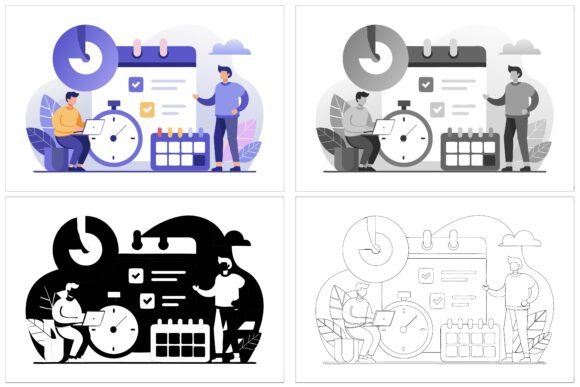
Once you decide to build a time management work plan, having the right tools can make the process smoother and more enjoyable. Visual elements such as charts, icons, and illustrations can help you map out your priorities, track progress, and communicate your plan to others. This is where having access to well-designed graphics becomes useful. The hello welcome to our special AI EPS collections provides a set of versatile illustration resources that can be used to create visual schedules, infographics, and planning boards.
These AI EPS illustration sets are particularly helpful because they include three variations of each design, available in AI, EPS, and JPG formats. Whether you use a Mac or a Windows machine, you will have no trouble opening and editing them. The files and layers are neatly organized, which saves time when you want to customize colors or rearrange elements. Perfection in details and consistency across the set means you can use them in both print and digital formats—whether for a wall planner, a presentation, a website, or an app interface.
For instance, if you are creating a weekly planning board for your office or home workspace, you can select relevant icons to represent different types of tasks—meetings, creative work, exercise, family time, and rest. By modifying the colors and arranging the icons in a layout that suits your workflow, you end up with a personalized tool that is both functional and visually engaging. The same resources can be used for infographics that explain your time management strategy to a team or for symbols in a productivity app you are developing.
When comparing these illustrations to generic stock graphics, the main advantage is the level of thought put into the design. The set is created with attention to layer structure, making it easy to edit even for those with limited graphic design experience. You can change individual elements without affecting the rest of the composition. This is especially valuable if you need to adapt the visuals for different projects over time.
However, it is worth noting that premade illustration collections are not a substitute for a well-thought-out planning process. They are a resource to support your work, not a magic solution. If you are new to time management planning, focus first on understanding your priorities and building a realistic schedule. Then use these visual tools to make your plan clearer and more engaging.
Decision Factors When Choosing Your Tools and Approach
As you evaluate whether the concept of good time management work plan is right for you, consider a few practical factors. First, assess how much control you have over your time. If your day is largely dictated by others, a detailed plan may need to be more flexible. Second, think about your natural tendencies. Are you someone who finds structure comforting or suffocating? Be honest with yourself, because forcing a plan that fights your nature will not last.
Third, consider the resources you need to implement your plan. Beyond a notebook or app, you might benefit from visual aids like the AI EPS illustration collections mentioned earlier. These can help you create a visual representation of your plan that you can display prominently as a reminder. Fourth, decide how often you will review and adjust your plan. Daily check-ins are common, but some people prefer weekly reviews. The key is consistency, not frequency.
Finally, remember that no tool or method works perfectly for everyone. The concept of a good time management work plan is a starting point, not a prescription. You might combine it with other approaches, discard parts that do not serve you, and iterate until you find a rhythm that feels sustainable. The most successful plans are those that evolve along with the person using them.
Moving Forward with a Practical Plan
If you are ready to build your own time management work plan, start small. Pick one area of your life or work that feels chaotic and design a simple plan for it. Use whatever format feels comfortable—a notebook, a digital document, or a visual board created with the help of illustration resources. Focus on clarity and realism rather than perfection. After a week, review what worked and what did not, then adjust accordingly.
Over time, you will develop a system that is uniquely yours. The combination of thoughtful planning, self-awareness, and the right supporting tools can help you move from feeling constantly busy to feeling genuinely productive. The concept of good time management work plan is not about doing more; it is about doing what matters most with the time you have. That shift in perspective is often the first step toward lasting change.